How PV-ESS-Charging Solutions Help Europes Charging Infrastructure Overcome Grid Constraints
Last updated: 9 Aug 2026 | 1518 Views |

Europe's electric vehicle market is entering a new phase of accelerated growth. As the European Union continues to tighten carbon emission regulations, EV adoption has surged, driving unprecedented demand for charging infrastructure. For charging network operators, however, the challenge is no longer simply about installing more chargers. The real question is how to rapidly deploy reliable charging capacity in an environment characterized by limited grid availability, lengthy grid-connection approval processes, and increasingly volatile electricity prices.
Against this backdrop, PV-ESS-Charging solutions are rapidly evolving from a value-added option into a strategic necessity.
What Is a PV-ESS-Charging Solution?
At its core, a PV-ESS-Charging solution integrates solar photovoltaic generation (PV), battery energy storage systems (ESS), and EV charging infrastructure into a unified energy ecosystem.
Rather than functioning as a passive electricity consumer, the charging station becomes an intelligent energy node capable of generating, storing, consuming, and managing energy. During daylight hours, solar energy is prioritized for on-site consumption, while excess electricity is stored in batteries. When charging demand peaks or electricity prices rise, the stored energy can be discharged to support charging operations.
This approach addresses far more than the utilization of renewable energy. It helps solve some of the most pressing challenges facing charging infrastructure today, including operational economics, energy resilience, and long-term scalability.
DC-Coupled vs. AC-Coupled Architectures
PV-ESS-Charging systems are generally built around two architectural approaches: DC-coupled and AC-coupled.
In a DC-coupled architecture, PV generation, battery storage, and EV chargers share a common DC bus. Because fewer power conversion stages are required, the system can achieve higher theoretical efficiency. However, this architecture also demands more sophisticated system design, tighter component compatibility, and greater engineering complexity. As a result, it is typically best suited for greenfield projects where maximum efficiency is the primary objective.
In contrast, an AC-coupled architecture connects PV inverters, battery storage systems, and EV chargers through a common AC bus coordinated by an Energy Management System (EMS). While it involves one additional power conversion stage, the architecture offers greater deployment flexibility, easier expansion, and stronger compatibility with existing infrastructure.
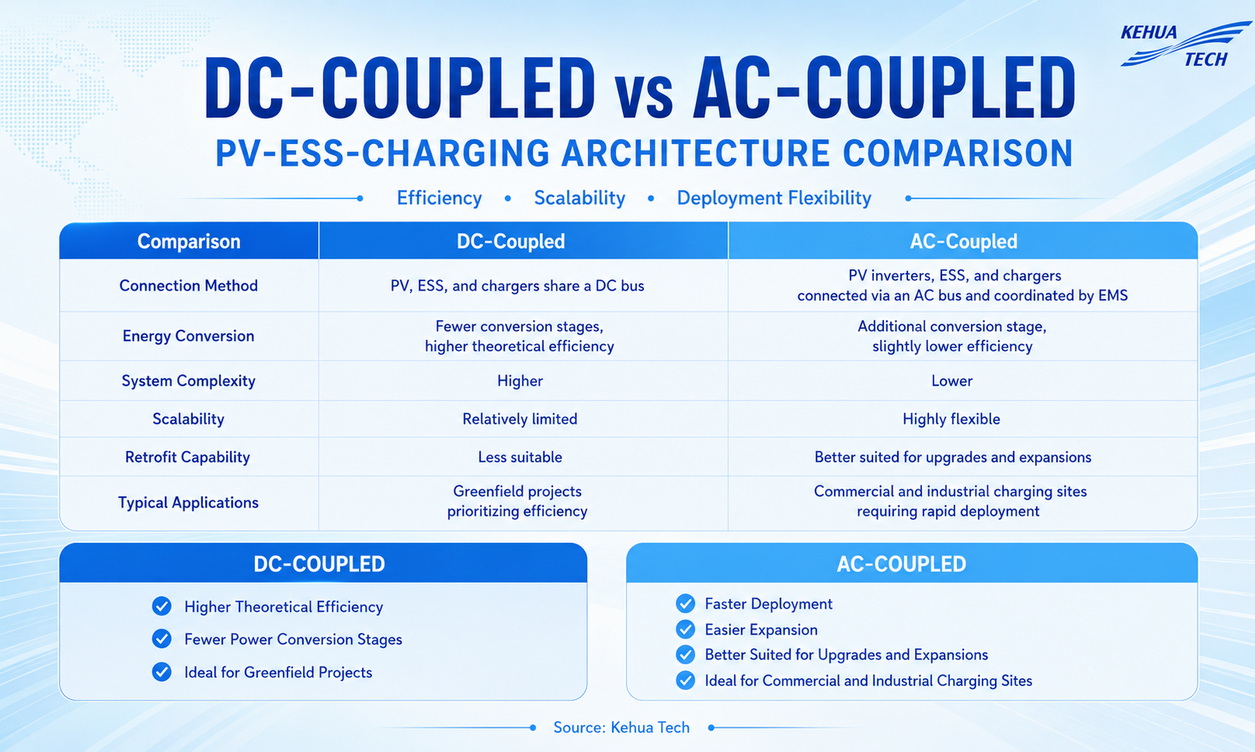
From a theoretical perspective, DC-coupled systems offer superior efficiency. However, real-world charging infrastructure projects often prioritize deployment speed, compatibility, and future scalability over marginal efficiency gains.
This is particularly true across Europe, where many charging projects are being developed within existing parking facilities, logistics hubs, commercial properties, and industrial parks. In these scenarios, the ability to integrate seamlessly with existing electrical infrastructure often outweighs the benefits of achieving maximum theoretical efficiency.
When viewed through the lens of practical project implementation, the value of AC-coupled PV-ESS-Charging solutions becomes increasingly evident.
One of the most significant barriers to charging station deployment in Europe is limited grid capacity. Obtaining additional grid connections, upgrading transformers, and securing regulatory approvals can add months—or even years—to project timelines.
An AC-coupled PV-ESS-Charging system addresses this challenge by leveraging battery storage as an energy buffer. During periods of peak charging demand, stored energy supplements grid power, reducing the need for immediate grid expansion. During off-peak periods, the battery can be recharged using either solar energy or lower-cost grid electricity.
This enables charging station operators to increase available charging power and improve operational flexibility without relying solely on costly and time-consuming grid upgrades.
Kehua's AC-Coupled PV-ESS-Charging Solution
Kehua offers a fully integrated AC-coupled PV-ESS-Charging solution covering the entire energy ecosystem, including PV inverters, commercial and industrial battery energy storage systems, integrated DC fast chargers, distributed charging systems, and intelligent energy management platforms.
The charging portfolio includes integrated chargers ranging from 60–180 kW and 240–400 kW, as well as distributed charging systems covering 240–480 kW and 600–800 kW configurations. For ultra-fast charging applications, the system can be expanded in parallel up to 1.6 MW, providing exceptional flexibility for sites of varying sizes and future growth requirements.
For charging network operators, this means not only meeting today's charging demand but also creating a scalable foundation for tomorrow's expansion.
Beyond Deployment: Delivering Long-Term Economic Value
The value of a PV-ESS-Charging solution extends far beyond successful project deployment.
In Europe, where electricity costs remain volatile, battery storage enables peak shaving and load shifting strategies that significantly reduce electricity expenses. Under time-of-use tariffs, solar energy can be prioritized for self-consumption, while surplus generation is stored for use during high-price periods. This reduces dependence on the grid and improves overall energy economics.
At the same time, battery storage enhances site resilience by maintaining charging operations during grid constraints, power fluctuations, or temporary outages. The result is improved charging availability, enhanced power quality, and greater operational reliability.
In other words, PV-ESS-Charging solutions address not only grid constraints and deployment challenges, but also help operators lower operating costs, improve profitability, and strengthen long-term energy security.
Europe's charging infrastructure is evolving from a collection of charging points into a network of intelligent energy assets.In the future, competitive advantage will not be defined solely by charging power. Instead, success will depend on the ability to integrate renewable energy, balance grid demand, optimize operating costs, and improve system resilience. PV-ESS-Charging solutions represent a critical step in that transition. Through its AC-coupled architecture, Kehua integrates solar generation, energy storage, and EV charging into a scalable, replicable, and commercially viable energy platform—providing a practical pathway for the next phase of Europe's charging infrastructure development.
For more information: www.kehuasz.com
About Kehua
Founded in 1988 and headquartered in Xiamen, Kehua began as a pioneer in renewable energy. The company was listed on the Shenzhen Stock Exchange in 2010 and entered the EV charging sector in 2014, leveraging decades of expertise in power conversion technologies.
Today, Kehua operates across four core business areas:
- EV charging infrastructure
- Power solutions (UPS)
- Renewable energy (solar inverters and ESS)
- Data center solutions
The company employs more than 4,000 professionals worldwide.
Kehua places strong emphasis on innovation, investing 7–9% of its annual revenue in R&D. It holds over 2,100 patents and intellectual property rights and employs top-tier experts recognized by China’s State Council.
With six manufacturing facilities spanning 460,000 square meters across China and Malaysia, as well as specialized testing laboratories (including EMC and waterproof testing), Kehua maintains rigorous quality standards across its global operations.
Source : Shenzhen Kehua


